
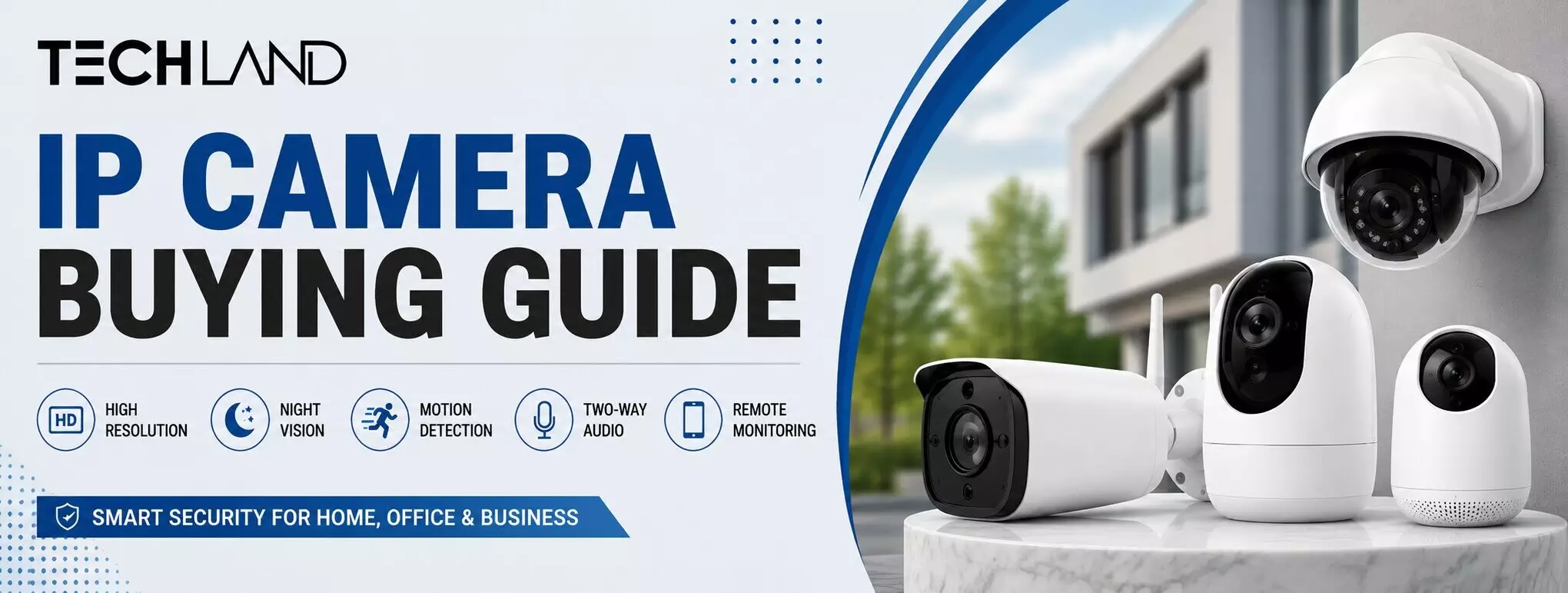
IP Camera Buying Guide
When choosing an IP camera, it's not always about getting the highest megapixel camera or the cheapest you can find. The right camera for you depends on where you want to put it, how much area you need to watch, whether you want Wi-Fi or wired networking, and how you want to store your recordings.
A small home Wi-Fi camera with night vision, motion detection, and two-way audio might be sufficient for a home. A shop, office, warehouse, or factory may need multiple PoE cameras, an NVR, larger storage, and better coverage.
This IP camera buying guide explains the important things to consider before buying an IP camera in Bangladesh. So, you can choose a model that actually fits your security needs.
What Is an IP Camera?
An IP camera (Internet Protocol camera) is a type of digital video camera that can send and receive data over a computer network. Unlike traditional analogue CCTV cameras, an IP camera can connect to the network via either Ethernet or Wi-Fi, allowing the user to monitor footage from compatible phones, computers, NVRs, and other devices.
IP cameras today provide high-resolution video, night vision, motion detection, two-way audio, memory card recording, smart detection, and remote viewing.
The most important thing is to choose the camera for your installation environment, not just buy based on specifications.
What to Consider Before Buying an IP Camera
First, decide how and where you will use the camera before comparing different IP camera models.
Choose an indoor or outdoor IP camera.
Indoor cameras are designed for environments that are protected from direct exposure to rain or harsh weather.
Outdoor cameras need better protection against dust, moisture, and changing weather conditions. If you're installing a camera outdoors, check the weather-resistance rating before purchase.
A camera designed for indoor use should not automatically be used outdoors just because it has night vision.
Choose the Right IP Camera Resolution
The resolution of a camera is the amount of detail it can capture. IP cameras are commonly available in 2MP, 4MP, 5MP, and higher resolutions.
2MP IP Camera
A 2MP camera is suitable for basic monitoring in smaller areas, such as rooms, entrances, and small shops. It can be a practical option if you don't need very detailed footage.
4MP IP Camera
A 4MP IP camera has more image detail and is a popular choice for homes, shops, offices, and general security surveillance.
5MP and Higher Resolution
Higher-resolution cameras are useful if you require greater detail from a larger or more demanding surveillance area. These can be especially useful for outdoor monitoring or places where clearly identifying people or objects is important.
But more megapixels don't necessarily make a camera better. The lens quality, sensor, lighting, viewing angle, and night vision all affect the final image.
Wi-Fi vs PoE IP Camera: Which One Should You Choose?
One of the biggest decisions when buying an IP camera is choosing between Wi-Fi and PoE connectivity.
Wi-Fi IP Camera
A Wi-Fi IP camera connects to your wireless network, which can make installation easier, as you do not need an Ethernet cable for network connectivity.
Wi-Fi cameras are usually handy for houses, small shops, small offices, and places where running an Ethernet cable is challenging, but the camera still generally needs a power source. Also, make sure the Wi-Fi signal is strong where you'll be installing the camera.
PoE IP Camera
PoE stands for Power over Ethernet. A PoE IP camera can get network data and power from a compatible Ethernet connection. This makes PoE cameras useful for more structured surveillance systems, particularly when installing multiple cameras.
PoE is more suitable for offices, stores, storage, manufactories, and bigger homes' professional surveillance systems. If you are planning multiple cameras with an NVR, a PoE-based setup can offer a cleaner and more reliable installation.
IP Camera Feature
Once you have decided on the camera type and resolution, compare the features you will actually use.
Night Vision
Night vision is essential if the camera needs to monitor an area after dark. Many IP cameras use infrared technology to provide visibility in low-light conditions. Before buying, check the stated night-vision range and consider the actual distance between the camera and the area you want to monitor.
Motion Detection
Motion detection allows the camera to detect movement and can trigger recording or send alerts to a connected device. This can reduce unnecessary recordings and make it easier to notice important activity. Some newer cameras also provide smart detection features that can distinguish between people, vehicles, and other types of movement.
Two-Way Audio
Two-way audio lets you listen to the area around the camera and speak through it using a built-in microphone and speaker.
This feature can help with home entrances, stores, drawing rooms, offices, and delivery locations. For example, you might be able to talk to someone at your door without physically walking to the entrance.
Memory Card Support
Some IP cameras support microSD cards for local recording. This can be convenient for a single-camera setup where you do not want to install an NVR.
However, storage capacity depends on factors such as resolution, recording mode, frame rate, and how long you want to retain footage.
Cloud Storage
Some camera systems also offer cloud-based recording. Cloud storage can make footage accessible even if the camera or local storage device is damaged.
However, cloud features can vary between brands and models, and some services may require a subscription. Check the manufacturer's terms before relying on cloud recording as your primary storage method.
How Much Storage Does an IP Camera Need?
When people buy security cameras, they often overlook storage. For a single indoor camera, a memory card may be sufficient. For several cameras or continuous recording, an NVR with a suitable surveillance hard drive is generally more practical.
Memory Card Storage
A microSD card is convenient for smaller installations. The amount of footage you can store depends on the card capacity and recording settings.
NVR Storage
An NVR, or Network Video Recorder, is designed to record footage from network cameras. It is a better option for larger surveillance systems that require continuous recording or footage from multiple cameras.
If you are planning a complete surveillance setup, consider the camera count, recording resolution, recording hours, and required retention period before selecting the NVR storage capacity.
How Many IP Cameras Do You Need?
The number of IP cameras you need depends on the size of the property, entry points, important areas, and how much coverage you want. A small home may need only two or three cameras, while a shop, office, warehouse, or factory may require more cameras to cover entrances, work areas, storage spaces, and outdoor areas.
For a Small Home
You may only need cameras covering the main entrance, important indoor areas, and the back or side entrance.
For a Shop
A typical setup may include the entrance, sales area, cash counter, and storage area. The camera positions should be planned to minimise blind spots.
For an Office
Consider the main entrance, reception, corridors, important work areas, and other locations where monitoring is necessary.
For a Factory or Warehouse
Larger properties may require multiple cameras covering entrances, production areas, storage sections, loading zones, parking areas, and outdoor boundaries.
In larger installations, using PoE cameras with an NVR can make the system easier to manage.
Which IP Camera Is Best for Different Users?
There is no single IP camera that is best for everyone.
Best IP Camera for Home
For home use, look for features such as Wi-Fi connectivity, night vision, motion detection, two-way audio, and mobile monitoring.
A compact camera may be enough for an indoor room, while an outdoor entrance may require a weather-resistant model.
Best IP Camera for Shop
For shops, prioritize coverage, night vision, reliable recording, and storage. If the shop has several important areas, multiple cameras connected to an NVR may be more suitable.
Best IP Camera for Office
Office surveillance may require multiple cameras, reliable network connectivity, good image quality, and centralized recording.
Best IP Camera for Outdoor Use
For outdoor areas, pay close attention to weather resistance, night vision, viewing angle, mounting position, and the distance you need to cover.
IP Camera Installation Tips
Even a good camera can perform poorly if it is in the wrong place. Before installing: Select a position where you can clearly see the area of interest. Do not aim the camera directly at strong light sources. Watch for blind spots. Install outdoor cameras in protected areas from the weather. Be sure cables and connections are well protected. Test the camera in daytime and nighttime. Lock down your network and change default logins. The objective is not to place as many cameras as possible. If you put them in the right places, you can often get better coverage with fewer cameras.
Common Mistakes to Avoid When Buying an IP Camera
Many buyers make the same mistakes when selecting a security camera.
Choosing Only by Megapixels
A higher resolution does not guarantee better performance in every situation. Sensor quality, lens, lighting, and night vision also matter.
Ignoring Nighttime Performance
If you need security monitoring around the clock, daytime image quality is only part of the decision.
Forgetting Storage
Before buying a camera, decide whether you will use a memory card, NVR, cloud storage, or a combination of these.
Ignoring Wi-Fi Coverage
A Wi-Fi camera may be easy to install, but poor wireless coverage can affect performance.
Choosing the Wrong Outdoor Camera
Outdoor installations require suitable weather protection. Always check the product specifications before installing a camera outside.
Not Checking NVR Compatibility
If you are building a multi-camera system, make sure the cameras and NVR are compatible before purchasing the complete setup.
IP Camera Price in Bangladesh
The price of an IP camera in Bangladesh depends on many variables, including brand, resolution, connectivity, night vision range, storage support, audio features, smart detection, weather protection, and other specifications.
Please do not buy a camera just because it is cheap; first find out what features you actually need. Then compare models that fit your budget.
For the latest available models and IP camera prices in BD, you can browse through Techland BD's IP camera collection and compare the available options.
FAQ
Which IP camera is best for home security?
For home security, look for a camera with excellent image quality, night vision, motion detection, two-way audio, and reliable mobile monitoring. The best model depends on whether you need indoor or outdoor coverage.
Is a Wi-Fi IP camera better than a PoE IP camera?
Neither is automatically better. Wi-Fi cameras are convenient for smaller installations, while PoE cameras are often better suited to structured and multi-camera surveillance systems.
How many megapixels should an IP camera have?
For basic monitoring, 2MP can be sufficient. A 4MP camera can provide more detail for general home, shop, and office surveillance, while higher resolutions can be useful for larger or more demanding areas.
Do IP cameras work without the internet?
Many IP cameras can continue recording locally through a memory card or NVR even when internet access is unavailable. However, features such as remote viewing and cloud access generally require an internet connection.
Where to buy reliable IP cameras online in Bangladesh?
You can buy reliable IP cameras online from Techland BD, which offers IP cameras from brands such as Hikvision, Dahua, TP-Link, EZVIZ, IMOU, and Uniview. The available models cover different requirements, including home, office, shop, and outdoor surveillance. Techland BD also provides warranty support and nationwide delivery, making it a convenient option for buying IP cameras online in Bangladesh.
Discussion
0Leave a Comment
No comments yet
Be the first to share your thoughts
