
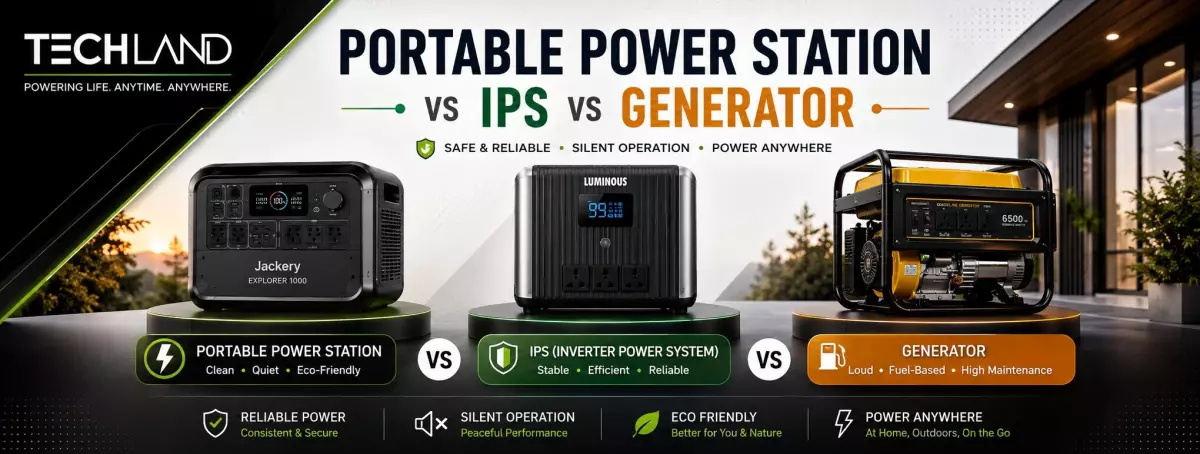
Generator vs IPS vs Portable Power Station
Regular load shedding can impact anything from daily household chores to work and business activities. A sudden power cut can stop your Wi-Fi router, desktop computer, fans, lights, CCTV cameras, or other essential devices when you need them the most. Therefore, many Bangladeshi people consider a generator, an IPS, or a portable power station as a backup power solution. All three are meant to provide electricity when the power fails, but they work in different ways and are appropriate for different situations.
A generator makes electricity from a fuel source. An IPS stores electricity in a battery and, with an inverter, serves as a backup power source. A portable power station is a compact unit that combines a battery, inverter, charging system, and multiple output ports. Choosing between them is more than simply picking the most powerful one. Think about your appliances, required backup time, budget, available space, noise tolerance, maintenance requirements, and portability.
This article will assist you in understanding the key differences among a generator, an IPS, and a portable power station, and in choosing the right power backup solution for your home, office, shop, or outdoor use in Bangladesh.
Generator, IPS and Portable Power Station Explained
Before we compare the three backup systems, it helps to understand how each one works and where it fits best. The main use of a generator is to generate electricity from fuel and to handle heavier loads. An IPS is a backup system, typically installed as a fixed unit, that uses stored battery power. A portable power station also has a battery, but it is made to be easily moved and used in different places. The right choice depends on what you need to power and how you plan to use the backup system.
How a Power Generator Works
A power generator is a device that produces power using an engine running on fuel such as diesel, petrol, or another appropriate fuel type, depending on the model. The engine drives an alternator to generate electric power for attached appliances.
The big advantage of a generator is that it can take high electrical loads. When sized correctly, a generator can power multiple household appliances, office equipment, commercial equipment, and other high-power devices during an extended power outage.
Generators are often a good choice for larger homes, shops, restaurants, offices, construction sites, and businesses where battery-based backup might not provide enough power.
But there are limitations to generators. They need fuel, regular maintenance, and proper ventilation. You can also hear the engine noise. Do not run a generator indoors in an enclosed space due to exhaust emissions. A generator can have much more capacity than necessary for users who only need to power a Wi-Fi router, laptop, lights, or a few fans.
How an IPS Works
An IPS, or Instant Power Supply, stores electrical energy in a battery while the main electricity supply is available. If the power goes out, the inverter converts the stored DC power into AC electricity to power compatible appliances. In Bangladesh, an IPS is frequently used for house power backup. It can provide backup power for lights, fans, TV, Routers, computers, and other household equipment, depending on inverter capacity and battery size.
One of the big advantages of an IPS is automatic backup. When properly installed, it can switch to battery power if the main electrical supply fails.IPS systems are also quieter than fuel-powered generators, making them a better fit for homes and offices.
However, the backup time depends on the battery capacity and the load connected to it. Batteries also lose capacity with time and may eventually need replacement. For users looking for a fixed home or office backup system
How a Portable Power Station Works
A portable power station is a rechargeable, battery-powered backup system that can be utilized flexibly. A portable power station differs from a regular IPS installation in that it is usually a single unit containing the battery, inverter, charging system, and a variety of output ports. Depending on the model, it can have AC outlets, USB-A, USB-C, DC outputs, wireless charging, UPS, and solar charging.
Portable power stations can charge laptops, smartphones, routers, lights, cameras, monitors, small appliances, and other electronic devices. Larger models can also handle more demanding appliances, as long as their output rating is adequate.
Its main advantage is its portability. It can be moved from room to room, taken to the office, used while travelling, or carried outdoors. Many modern models also support solar charging, which is useful during long power outages or outdoor activities.
Generator vs IPS vs Portable Power Station
The three technologies have different strengths, so comparing them based on actual usage is more useful than simply looking at price or power capacity.
|
Comparison Factor |
Generator |
IPS |
Portable Power Station |
|
Power source |
Fuel |
Battery |
Battery |
|
Portability |
Low |
Low |
High |
|
Operating noise |
High |
Very low |
Very low |
|
Fuel required |
Yes |
No |
No |
|
Indoor suitability |
No |
Yes, with proper installation |
Yes, according to manufacturer guidelines |
|
Heavy-load support |
Very high |
Depends on inverter |
Depends on model |
|
Backup time |
Long with fuel |
Depends on battery |
Depends on battery |
|
Maintenance |
High |
Moderate |
Low |
|
Solar charging |
Usually requires separate setup |
Possible with suitable system |
Available on many models |
|
Charging method |
Fuel |
Mains electricity |
AC, solar, car and other methods depending on model |
|
Portability |
Poor |
Poor |
Excellent |
|
Best suited for |
Heavy loads and long outages |
Fixed home backup |
Portable and flexible backup |
The comparison shows that there is no universal winner. The best option depends on your power requirement and how you plan to use it.
Choosing the Right Power Backup for Different Needs
Different users have different backup needs. A household that needs only lights and fans does not need the same system as a restaurant or an office.
For Home Use
An IPS is a good solution for homes that need a reliable backup for lights, fans, televisions, routers, and other essential appliances.
If you want to move the backup system between rooms or use it for laptops, phones, routers, cameras, and other electronics, a portable power station may be more convenient.
When choosing between an IPS and a portable power station, the load for larger household appliances should be determined.
For Office and Business
Businesses usually have more demanding power needs. Computers, networking equipment, CCTV systems, printers, lights, and other devices may need to be kept running during an outage. An IPS is great for fixed office backup, while a high-output portable power station is useful for small workstations or temporary backup. For businesses that operate heavy appliances or equipment for several hours, a properly sized generator may be more appropriate.
For Apartments
Noise and free space are important for the user of the flat. Fuel generators typically aren't suitable for indoor or enclosed residential use. An IPS can offer fixed backup, while a portable power station is useful if you want a small system that you can move around easily. A portable power station can be especially useful for powering a laptop, router, monitor, lights, and other small electronics.
For Heavy Appliances
Generators are better suited for high-load appliances, as they will provide high continuous power if properly sized. Refrigerators, pumps, air conditioners, and other motor-driven appliances may also need additional startup power. Therefore, before you choose a backup system, check both continuous and surge requirements.
For Computers and Networking Devices
Computers, monitors, routers, ONU devices, and networking equipment need reliable backup power. If you have a permanent desktop setup, a decent UPS or IPS can be a good pick. A portable power station with proper UPS functionality can be handy too. However, not all portable power stations are made to work as a dedicated UPS. Check the UPS mode, transfer time, output waveform, and maximum load before connecting sensitive equipment.
Important Factors Before Buying a Power Backup
Choosing the right backup system starts with understanding your actual electricity requirements.
Power Requirement
First, decide which devices you want to keep running during a power outage. The electricity required to run a Wi-Fi router and a laptop is much less than that required to run an air conditioner, refrigerator, water pump, or many high-power appliances. Add the wattage of the appliances you plan to use simultaneously. This should give you a better idea of the required output capacity.
Battery Capacity
The capacity of a battery-based system determines how much energy it can store. Capacity for portable power stations is usually given in watt-hours (Wh). A higher Wh rating generally indicates more stored energy, but the actual runtime also depends on the load and conversion efficiency. The backup time of an IPS system depends on the battery capacity and inverter efficiency.
Output Wattage
The wattage output is just as important as the battery capacity. There may be a large battery at a power station. Still, it is not suitable for a particular appliance unless the inverter can provide sufficient continuous or startup power. Always compare the device's power requirements to the backup system's continuous and surge outputs.
Battery Technology
Battery technology can influence the life span, weight, charging performance, and overall reliability. Many modern portable power stations use LiFePO4 batteries, which are well known for their long cycle life and stable performance. But do not let battery chemistry be the only thing you think about. Capacity, output, charging speed, warranty, safety features, and build quality also matter.
Charging Options
AC charging is the most popular method of charging supported by portable power stations, but some also support car charging, solar charging, or multiple charging methods. Solar charging can be especially useful when there is no electricity available for an extended period. If your main concern is solar charging, find out the maximum solar input and the supported voltage range for the specific model.
Noise and Installation
Generators can be loud to run, while IPS and portable power stations are much quieter. You will need to install the electrical installation and set up the batteries in the IPS. Still, the portable power station is usually off-the-shelf and ready to go after charging. Noise can be a key factor when choosing a backup system, particularly in apartments, bedrooms, offices, and quiet work environments.
Generator vs IPS: Which Fits Better?
When you need a lot of power for a long time, a generator is usually the better choice. It can generate electricity as long as there is enough fuel. This makes it useful for businesses, large homes, workshops, and other places where heavy power is required.
For everyday home and office backup, an IPS is more convenient. It's quiet and doesn't use fuel. An IPS might suffice if all you need is lights, fans, Wi-Fi, TV, and other basic appliances. If you have high-powered appliances and longer outages, you might be better off with a generator.
IPS vs Portable Power Station
Both systems are battery-powered, but they cater to different types of users. Normally, an IPS is installed as a fixed backup. Helpful if you already know which appliances or circuits you want backed up.
Portable power stations are made to be versatile. You can take it with you, bring it to work, use it outdoors, or move it from room to room. An IPS may be more practical for permanent home backup. Portable power stations offer greater flexibility for portable and multi-purpose backup power.
Generator vs Portable Power Station
Generators have the edge if you need high continuous power. If quiet operation, portability, easy setup, and low maintenance are more important, portable power stations are better suited.
For example, a large household or business that needs to run heavy equipment during long outages may benefit from a generator. For someone who mainly needs backup for a laptop, router, camera, lights, or small electronics, a portable power station is often more practical.
Portable Power Station and Solar Charging
Another handy feature on many contemporary portable power stations is solar charging. The battery can be recharged during the day by compatible solar panels, storing energy for later use. This can be very handy during prolonged load shedding, when working outdoors, while traveling, camping, or in emergencies.
However, solar charging performance is affected by sunlight, panel capacity, weather, and the power station's maximum solar input. So if you are planning on using solar charging, be sure to check the solar input supported by the power station before buying a compatible panel.
Battery-Based Backup vs Fuel Generator
The distinction between battery backup and a generator is more obvious from a daily convenience standpoint. A generator makes noise and exhaust and needs fuel. It needs regular maintenance as well. An IPS or a portable power station stores the electricity in a battery. It can work without fuel or an engine.
Battery backup can be especially handy for smaller electronic loads, because you don't need to run a fuel-powered engine to keep a laptop or router running. But for high power loads and long outages, generators still have an important edge.
Which Power Backup Requires Less Maintenance?
Generators are most often the most maintenance-intensive because they have an engine, fuel system, oil, and moving parts. An IPS requires less mechanical maintenance, but the battery will eventually lose capacity and may need to be replaced.
Portable power stations generally require the least routine maintenance because they don't have an engine or fuel system. Whatever the type, be sure to follow the manufacturer's recommendations for charging, storage, and safety to keep the system properly maintained.
Power Backup Safety in Bangladesh
Always be aware of safety when working with backup power equipment. Never operate fuel-powered generators in homes, rooms, garages, or other enclosed spaces due to exhaust emissions.
Battery-based systems also need to be used with care. Do not use damaged or swollen batteries, block ventilation openings, and use the correct charger and cables. For high-power systems, don't attempt unsafe electrical modifications; follow the manufacturer's installation and operating instructions.
Frequently Asked Questions About Power Backup
Which is better for home use, a generator or IPS?
For regular household backup, an IPS is usually more convenient because it operates quietly and does not require fuel. A generator is better when higher power is needed for longer periods.
Is a portable power station better than an IPS?
Neither is universally better. An IPS is suitable for fixed household backup, while a portable power station is more flexible and easier to move.
Which power backup is suitable for an apartment?
An IPS or portable power station is generally more practical for apartments because both are quiet and do not produce fuel exhaust.
Can a portable power station run a refrigerator?
Some high-output portable power stations can run compatible refrigerators. However, you must check the refrigerator's running and startup power against the power station's continuous and surge output.
Where can I buy a power backup system in Bangladesh?
You can buy generators, IPS, UPS, and portable power stations from trusted technology retailers like Techland BD. Techland BD offers a range of power backup solutions for home, office, and business use.
Discussion
0Leave a Comment
No comments yet
Be the first to share your thoughts
