
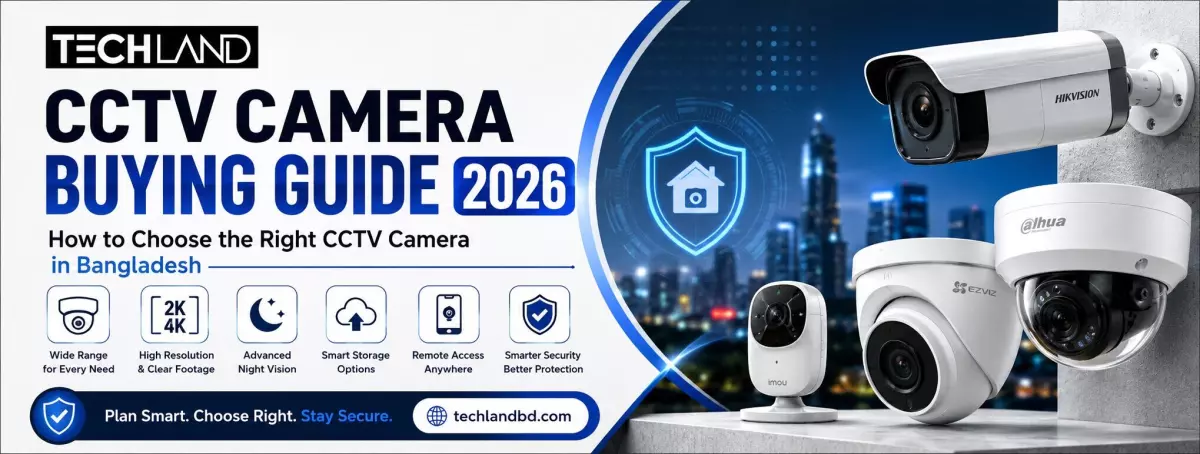
CCTV Camera Buying Guide
Security is no longer something only big companies have to worry about. Surveillance cameras are increasingly used to monitor key areas in homes, shops, offices, warehouses, schools, factories, and other properties across Bangladesh.
But buying a CCTV camera is more than simply picking the highest megapixel or the cheapest model. The final useful surveillance system will depend on the type of camera, resolution, lens, viewing angle, night vision, storage method, connectivity, installation location, and recording requirements.
A camera that works well in a bedroom may not be suitable for a shop entrance or factory boundary. Also, a simple wifi camera can be sufficient for a small room. A large commercial property may require multiple IP cameras with an NVR.
This 2026 CCTV camera buying guide explains the key factors to consider before choosing a security camera in Bangladesh. If you're looking for surveillance for your home, shop, office, or business, this article will help you know what actually matters before you buy anything.
CCTV Camera or IP Camera
The first big decision is determining whether you need a traditional CCTV camera or an IP-based surveillance system. Old school CCTV cameras generally send video over coaxial cable to a DVR. These are still a good choice for homes and businesses that want a basic wired surveillance system.
An IP Camera sends digital video over a network using Ethernet or, depending on the model, wifi. IP cameras can support higher resolutions, remote monitoring, PoE, smart detection, and other network-based features. Techland BD currently offers IP cameras from brands including Hikvision, Dahua, EZVIZ, Jovision, Uniview, TP-Link, Tenda, IMOU, and others.
Neither option is automatically the best. Your choice should depend on the property, the number of cameras, the wiring, the recording method, and the features you actually need.
Traditional CCTV Camera
CCTV cameras are connected to a DVR via coaxial cable. They are great if you want to record locally non-stop without depending too much on a network connection. They are a practical choice for homes, small shops, offices and existing CCTV installations where compatible cabling is already in place.
IP Camera
IP cameras transmit digital video over a network and typically work with an NVR for centralized recording. They are useful if you need higher-resolution footage, multiple cameras, remote access, PoE connectivity, or smart surveillance features. An IP camera system can provide greater flexibility and easier future expansion for larger homes, offices, shops, warehouses, and commercial properties.
Choosing the Right CCTV Camera for Indoor and Outdoor Use
The kind of camera you buy should be determined by where you put it. An indoor camera doesn't need the same level of weather protection as an outdoor camera. Outdoor cameras, though, must cope with rain, dust, heat, and changing weather conditions.
Dome Cameras for Indoor Areas
Dome cameras are small and can be used in homes, offices, shops, reception areas, and corridors. They are quite discreet to look at, and many models have a wide viewing angle. Others are also built with additional tamper protection.
Dome or turret cameras can be a good choice for indoor surveillance when you want good coverage without a lot of attention drawn to the camera.
Bullet Cameras for Outdoor Surveillance
Bullet cameras are designed to be more directional and are often used for outdoor locations such as gates, entrances, driveways, parking areas, and building exteriors.
When observing a certain area from a distance, it can be helpful to have a pointed direction of view. Always check the camera's weather protection and night vision specs before purchasing for outdoor installation.
Turret Cameras for Flexible Installation
Turret cameras are a popular choice for outdoor areas, homes, shops, and offices. They can be placed flexibly and come in various resolutions, lens sizes, night-vision technologies, microphones, and smart detection features.
Turret cameras can be a good middle-ground option when you want adjustable camera design flexibility without switching to a PTZ system.
PTZ Cameras for Large Areas
PTZ stands for Pan, Tilt, and Zoom. A PTZ camera can pan, tilt, and zoom in on a specific area. This makes it useful for larger properties where a static camera might not offer enough coverage.
PTZ cameras are great for active monitoring in factories, warehouses, parking areas, commercial properties, and large compounds. However, PTZ cameras are generally more costly than fixed cameras, so they are best suited for applications where their movement and zoom capabilities actually add value.
How Many CCTV Cameras Do You Need?
Each property is unique and needs a different number of cameras. Start by listing the main areas you would like to track. For a home, these may be the main entrance, gate, parking area, staircase, or other vulnerable points. For a shop, coverage may be required for the entrance, cash counter, sales area, and storage room.
Identify potential blind spots as well. A camera with a wide-angle view can cover more area. But sometimes two cameras with different angles of view are better than one camera trying to cover everything. For larger properties, it's also worth considering future expansion. If you think you might add more cameras later, choose a recorder with more channels instead of buying one that's maxed out.
CCTV Camera Resolution
Resolution determines how much detail a camera can pick up. Typical resolutions for CCTV and IP cameras are 2MP, 3MP, 4MP, 5MP, 6MP, and above. The higher-resolution camera can provide more detail, which is very useful when observing faces, vehicles, or objects at a distance.
But higher resolution also takes more storage and bandwidth. For general home monitoring, 2MP or 3MP might be enough for many situations. If you need more detail on an entrance, cash counter, parking area, or larger space, 4MP, 5MP, or higher can make more sense.
But do not choose a camera just on megapixels. Other factors that influence the final footage include the image sensor, lens, lighting conditions, compression technology, and recording device.
Lens and Viewing Angle Matter
The lens determines how wide or narrow the camera can view. Wide-angle lens. Useful if you want to monitor a room, shop floor, or other relatively large area from a short distance. A narrower lens is better for overseeing a gate, entrance, corridor or distant object.
The standard lens sizes are 2.8mm and 3.6mm, but different models are available with different focal lengths. Think about how far away the camera is from the area you want to monitor when you buy it. A camera with poor optics might have a high resolution in a technical sense, but it might be unable to capture useful detail at the required distance.
Night Vision
When lighting conditions deteriorate, a surveillance camera needs to produce usable footage. Many cameras use infrared LEDs for black-and-white night vision, but some newer models offer color night vision via improved sensors, white-light illumination, or hybrid illumination.
When shopping for cameras, look for the stated night vision or illumination range. But remember that real-world performance also depends on the surrounding light, the camera's position, the weather, and the objects being monitored. If you have outdoor locations such as gates, parking areas, and building entrances, night vision deserves special consideration.
Field of View and Camera Coverage
The field of view indicates how much of the surrounding area the camera can capture. The wide field of view can be good for rooms and open spaces since one camera can cover more space. But a very wide view can make far-away people or things look smaller.
That is why the widest possible angle is not always the best way forward. Select the viewing angle based on the distance from the camera to the area you want to monitor.
Storage
One of the most important parts of a CCTV system is recording. A good camera is of little use if you don't have a proper way to store and review its footage. There are some common storage methods, depending on the type of camera and surveillance system.
DVR for Traditional CCTV Systems
DVR (Digital Video Recorder) is mostly used with wired traditional CCTV cameras. It captures video from attached cameras and saves it to a hard drive. If you want to record locally and avoid cloud storage, a DVR system is a practical option.
NVR for IP Camera Systems
An NVR is designed for IP cameras. An NVR can record multiple IP cameras in one place. Depending on the model, it may feature high-resolution recording, PoE, remote management, smart detection, and other functions.
For larger IP camera systems, it is important to choose the right NVR channel capacity. Techland BD has NVR models for different surveillance needs, including 4-channel, 8-channel, 16-channel, and larger systems.
Memory Card Storage for wifi Cameras
Some standalone wifi cameras record directly to a microSD card. Very handy for small installations where you don't want a separate DVR or NVR installed. If you only need monitoring for a bedroom, living room, small office, or shop counter, a wifi camera with local storage on a memory card can keep things simple.
The Simplest CCTV Solution
If you need to monitor a small area, you may not need a full multi-camera CCTV system. The wifi camera can be a very convenient choice for bedrooms, living rooms, small shops, reception areas, or any other place where you want quick installation without running extensive cables.
A wifi camera connects to your wireless network and can be operated via a smartphone app. Depending on the model, it may support features such as motion detection, night vision, two-way audio, pan-tilt, remote viewing, and microSD storage. The main advantage is simplicity. Typically, you don't need a separate DVR or NVR with a single camera.
Wired vs wifi CCTV Camera
Wifi cameras and wired cameras both have their place. A wired CCTV/IP camera generally provides a more stable connection and is better suited to the permanent installation of multiple cameras.
If you don't want to run wires through walls or ceilings, a wifi camera is easier to set up and could be a better choice. Wifi may be very convenient for a rented flat, a bedroom, a small office, or a temporary monitoring requirement. For a factory, warehouse, large office, or multi-camera installation, a wired system may provide more consistent connectivity.
PoE Support for IP Cameras
A compatible PoE IP camera can receive power and network data over a single Ethernet cable. This can make for a much cleaner install, especially if several cameras are installed at different locations. PoE is particularly useful in offices, shops, factories, warehouses and other multi-camera installations. Ensure the camera, NVR, POE switch and power requirements are compatible before purchase.
Motion Detection and Smart Detection
Motion detection allows the camera or recording system to respond to movement. Basic motion detection can trigger recordings or alerts, while more advanced cameras include human and vehicle detection, queue-crossing detection, intrusion detection, and other intelligent features.
These technologies can help eliminate extraneous alerts caused by moving trees, pets, or other unimportant activity. Smart detection can be especially useful when you are using this for a home or a small business where you can not monitor the live feed all the time.
Two-Way Audio
Some security cameras today come with a microphone and speaker. This lets you hear what is happening around the camera and talk to someone through the camera using a mobile app.
For example, you could talk to a delivery person at your door, or to someone inside your home when you are not home. If audio is important to you, be sure to check the exact product specs, as not every CCTV or IP camera supports two-way audio.
Weather Protection for Outdoor Cameras
Outdoor cameras in Bangladesh have to withstand rain, dust, humidity, and heat. Before installing a camera outside, verify the camera's IP rating and operating temperature range. For example, a camera with an IP66 or IP67 rating is designed to provide greater protection against the elements than a camera designed for indoor use only. But the camera still has to be properly installed. Even a weatherproof camera can get into trouble if the cables, connectors, or mounting points are not well protected.
What Should You Check Before Buying a CCTV Camera?
First, know where you plan to install it before ordering. Choose whether you want the camera to be indoor or outdoor and how far the area you want to monitor is from the camera. Then you look at the resolution and the lens. A high-resolution camera is useful when you want more detail, but it may require more storage as well.
Next, decide how you want to capture the footage. A traditional CCTV setup typically uses a DVR, while an IP camera system generally uses an NVR. A standalone wifi camera may use a memory card or a cloud service. Finally, check features like night vision, motion detection, two-way audio, PoE, remote viewing, weather protection, and smart detection based on your actual needs.
Where to Buy CCTV Cameras in Bangladesh?
Choosing a reliable seller is important because a CCTV system often requires several compatible components rather than a single camera.
Techland BD offers CCTV Cameras, IP Cameras, wifi cameras, DVRs, and NVRs for various home, office, shop, and commercial surveillance needs.
You can compare the camera type, resolution, lens, night vision, storage, connectivity, and other specifications before choosing the right setup.
For a complete installation, remember to check compatibility between the camera, recorder, storage, cables, PoE equipment, and other necessary components.
Frequently Asked Questions About CCTV Cameras
Which CCTV camera is best for home use?
Dome, turret, and wifi cameras are practical choices for many homes. The best option depends on the area you want to monitor, required resolution, night vision, storage, and remote access.
Which CCTV camera is best for outdoor use?
Bullet and turret cameras are common choices for outdoor surveillance, while PTZ cameras are useful for larger areas where remote movement and zoom are required.
Is an IP camera better than a CCTV camera?
Not always. Traditional CCTV cameras are well-suited to conventional wired DVR systems, whereas IP cameras offer network connectivity and greater flexibility for modern surveillance setups.
Do CCTV cameras need an internet connection?
No. A traditional CCTV camera can record locally via a DVR without an internet connection. Internet access is mainly required for remote viewing, cloud services, and certain smart features.
Discussion
0Leave a Comment
No comments yet
Be the first to share your thoughts
